Our research includes the following types of studies
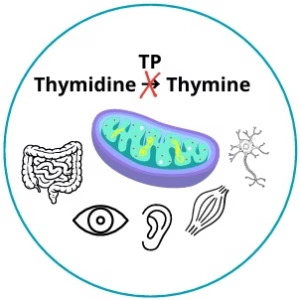
Status: Open to recruitment. Background Research Aims This study aims to collect existing patient data from clinicians worldwide, to understand how the rare mitochondrial disease, MNGIE, affects individuals (living or deceased), how their disease progresses over time, and how current treatments affect them. Who can take part? We are looking for clinicians who follow/have followed […]
Read more »
Status: Open to recruitment Background Amino acids are the building blocks of proteins. In order for the proteins to be ‘built’ the body needs both the amino acids and a small molecule called transfer RNA (tRNA). Mitochondrial tRNA synthetases (mt-ARS) are enzymes which are found in the mitochondria in our cells and are involved in […]
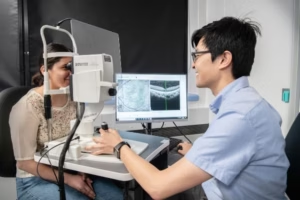
Status: Open to recruitment Background The researchers at the University of Cambridge and Cambridge University Hospitals are running a study called Virtual Reality-Based Visual Assessments in Inherited Optic Neuropathies (VisuALLeyes-ION). This study is led by the research team of Professor Patrick Yu-Wai-Man, an eye specialist who carries out research into inherited optic neuropathies at the […]
Status: Open to recruitment Background The Lily Foundation is the UK’s main patient organization for patients with mitochondrial disease. They are funding this study, which aims to get a genetic diagnosis for families who are thought to have mitochondrial disease but remain without a diagnosis after NHS testing. Objectives The study will look at existing […]
The aim of this study is to understand how the disease changes over time in order to identify a clinical outcome measure that could be used for future trials.
The aim of this study is to understand how inherited optic neuropathies progress over time. We plan to achieve this by assessing a number of visual parameters and analysing how these may change over a three-year period.
The aim of this natural history study is to evaluate the rate of change for patients with ADOA, by completing eye and vision assessments,, assessing quality of life and exploring factors associated with disease progression.
The aim of this study is to better understand the natural history and progression of disease caused by mutations in MTRFR/C12orf65, by building a database of clinical data on these participants. This will help us to guide the design of innovative new clinical trials, with the long-term goal of developing treatments for patients.
The aim of this study is to develop and test a questionnaire for individuals with an inherited optic neuropathy to report their experience of living with their condition and to assess their quality of life. We would like to do this with the help of individuals living with LHON and DOA.
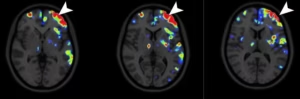
This is a small pilot study to see if we can use the molecule [11C]PK11195 to diagnose and study the progression of mitochondrial disease. We aim to determine whether [11C]PK11195 binding is abnormal in the brains and central nervous system of patients with mitochondrial disease.
We want to know whether high oxygen levels are toxic for humans with mitochondrial dysfunction, so that we only use these treatments when it is safe and helpful to do so.
The aim of this study is to investigate if the B vitamin, Nicotinamide Riboside (NR) can increase energy production and reduce symptoms in humans with mitochondrial disease.
This study is an international collaboration led by the University of Tübingen, Germany. The aim of this study is to better understand the clinical appearance and course of HSP, ataxia and related conditions (called a 'Natural History Study').
This study aims to identify the genetic causes of neuromuscular and other neurogenetic conditions, identify known and new disease genes and assess comparative genetic architecture of NMDs across four continents and to improve patient diagnosis and management of disorders, including delivery of personalized management plans
This study aims to measure the ‘age related penetrance’ of the genetic risk factors for dementia by comparing tests of brain function (including memory) to a person’s genetics and to establish the largest cohort of volunteers (~40,000) who can be recalled for future studies based on their detailed genetic and cognitive profile.
This study aims to provide patients with an explanation for their neurodegenerative disorder, to enable reliable genetic counselling and prenatal diagnosis, and to identify clinical biomarkers that could be used to monitor disease progression.
Nothing found